Knee Replacement in Poland: The UK Patient's Complete Guide (2026)

Executive Summary
Knee replacement is the single most in-demand elective orthopaedic procedure in the UK — and the one where NHS waiting times are longest. UK patients searching for alternatives abroad are choosing Poland in growing numbers: a two-hour direct flight, EU-regulated hospitals, surgeons using the same Stryker Triathlon and Zimmer Biomet Persona implant systems as UK private practice, and all-inclusive package costs up to 60% below UK private rates. This guide covers total and partial knee replacement in Poland, what the patient journey looks like, realistic recovery timelines, and the questions worth asking before you book.
For a complete UK patient guide to this procedure in Poland — procedure types, costs, recovery, and what to ask before booking — see our Best Country for Orthopaedic Surgery Abroad: UK Patient's Guide (2026).
Why knee replacement waits are pushing UK patients abroad
Research published in late 2024 confirmed that UK online searches for knee replacement treatment options are three times higher than for hip replacement — reflecting both the higher prevalence of knee arthritis and the longer, more frustrating waits for surgical intervention. PHIN data shows self-funded private knee replacements rose 122% post-pandemic as patients chose to fund their own surgery rather than wait.
The NHS trauma and orthopaedics waiting list exceeded 860,000 patients by late 2025. Knee replacement patients typically wait longer than hip replacement patients because the clinical threshold for surgery is set higher — pain and reduced mobility must be severe before NHS approval is granted, meaning patients often spend years with deteriorating function before they qualify.
A self-funded total knee replacement at a UK private hospital costs £12,000–£17,000 for the full package. For many patients this is simply unaffordable without borrowing. Poland provides a clinically equivalent alternative at significantly lower cost.
What to expect from knee replacement surgery
Total knee replacement (TKR) removes the damaged surfaces of the femur (thighbone), tibia (shinbone), and in most cases the underside of the patella (kneecap), replacing them with metal and plastic components. The knee is resurfaced rather than replaced in the same way a hip is — the ligaments and most of the surrounding soft tissue are retained.
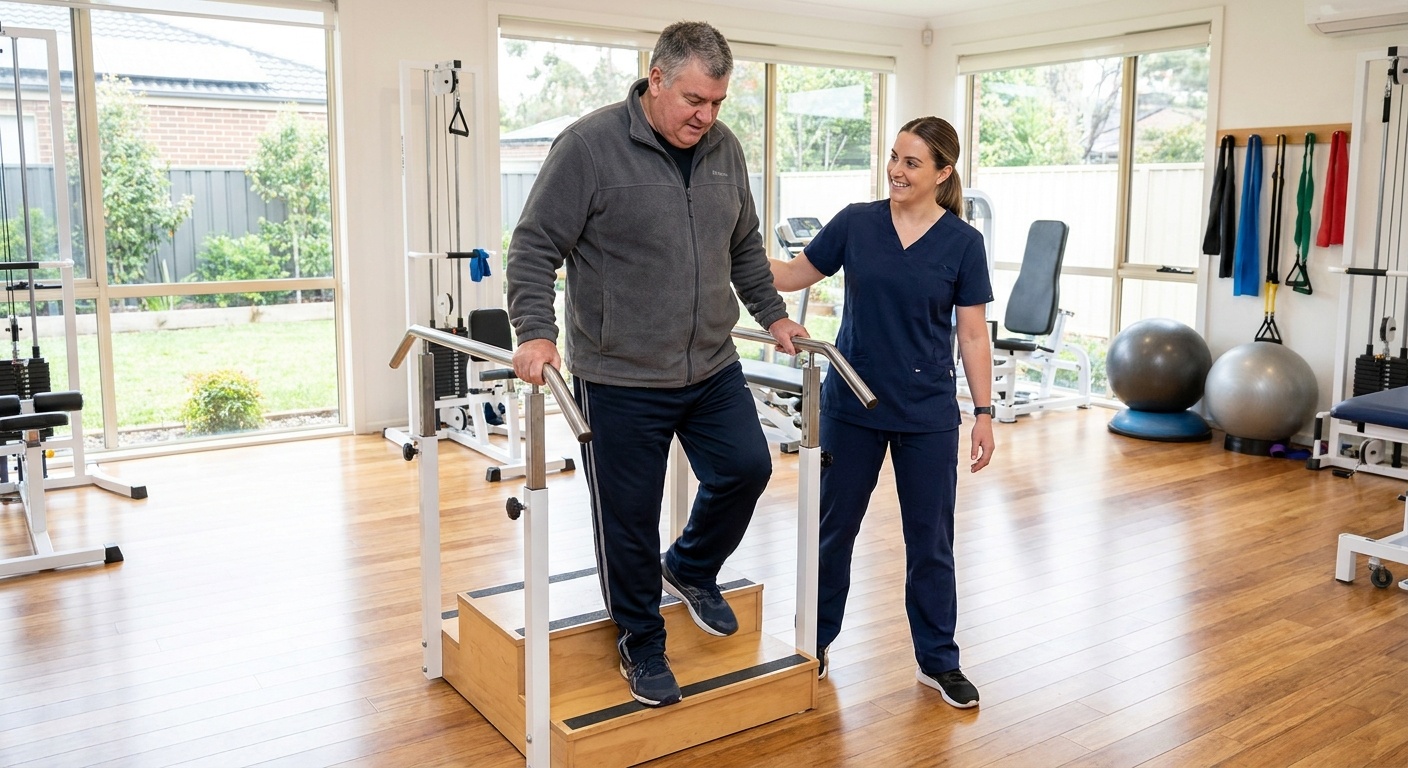
Most patients are walking with a frame on the day of surgery. The primary goal of inpatient physiotherapy is getting the knee bending to 90 degrees and the patient walking independently before discharge.
Procedure variants
Total Knee Replacement (TKR): The standard procedure for end-stage osteoarthritis affecting the whole knee joint. Both the medial and lateral compartments and the patellofemoral surface are resurfaced.
Partial (Unicompartmental) Knee Replacement: When arthritis is confined to one compartment of the knee — most commonly the medial (inner) side — a partial replacement resurfaces only the damaged area. The procedure is less invasive, involves a shorter inpatient stay, and allows faster recovery. Not all knees are anatomically suitable; a specialist assessment is required.
Revision Knee Replacement: Replaces a previously implanted knee that has become painful, loose, or mechanically failed. More complex than primary TKR; Polish specialist centres take UK revision cases.
Why Poland specifically
The same implants as UK private hospitals
Total knee replacement implant systems used in Polish partner clinics are manufactured by the same companies used across UK private hospitals: Stryker (including the widely used Triathlon system), Zimmer Biomet (including the Persona system), and DePuy Synthes. All components used in EU-member Poland carry CE marking under the same European Medical Device Regulation framework as UK-used implants. There is no difference in hardware quality.
Surgeon training and volume
Polish orthopaedic surgeons are trained under EU-standardised postgraduate pathways and registered with the Polish Chamber of Physicians. The high volume of procedures performed in Poland's major private hospital centres means that senior surgeons typically have case loads above 200 primary knee replacements per year — comparable to the busiest UK private knee surgeons.
Hospital accreditation and regulation
Poland's internationally-facing private hospitals hold ISO 9001 certification. EU membership means hospital regulation, patient rights, and pharmacovigilance operate under European legal frameworks. Thera Travel partner clinics are independently audited before referral.
Flight time matters more than you think
A knee replacement patient travels in a wheelchair, returns on crutches, and has a leg that cannot comfortably flex beyond 90 degrees for the first few weeks. A two-hour flight to Poland is a meaningfully different experience from a 4.5-hour flight to Turkey or a 10-hour flight to India. For patients who are already in pain, this is not a trivial consideration.
Cost comparison: Poland vs. UK private
| Procedure | UK Private (self-pay) | Thera Poland Package | Typical Saving |
|---|---|---|---|
| Total Knee Replacement | £14,000 – £16,500 | £5,500 – £6,500 | ~60% |
| Partial (Unicompartmental) Knee Replacement | £10,000 – £14,000 | Request a quote | ~45% |
| Revision Knee Replacement | £16,000 – £28,000+ | Request a quote | 35–50% |
UK private figures are indicative ranges drawn from published hospital tariff data. Thera Poland package prices cover all-inclusive stays (surgery, implants Stryker Triathlon or Zimmer Biomet Persona, 3–5 nights inpatient, transfers, physio, coordinator). Partial and revision procedures are quoted individually.
What's included in a Thera Travel Poland knee replacement package
| Item | Included? | Notes |
|---|---|---|
| Pre-op video consultation with surgeon | Yes | X-ray and imaging review; written surgical plan provided |
| Pre-operative blood tests and ECG | Yes | Completed on admission day |
| Surgery and all implant components | Yes | Stryker, Zimmer Biomet, or DePuy Synthes — confirmed in advance |
| Spinal or general anaesthetic | Yes | Anaesthetist fee included in the package |
| Inpatient stay (private room) | Yes | Typically 3–5 nights; revision cases longer |
| Daily physiotherapy and mobilisation | Yes | Twice daily; goal is 90-degree flexion before discharge |
| Airport transfers (both ways) | Yes | Wheelchair-accessible vehicle for the return journey |
| English-speaking patient coordinator | Yes | Available throughout your stay |
| Translated surgical notes for UK GP | Yes | Full operative report, implant batch numbers, discharge summary |
Recovery timeline
Knee replacement recovery follows a well-established pattern. The milestones below are realistic for most patients undergoing primary total knee replacement.
- Day of surgery: Walking with a frame within 4–6 hours of leaving theatre. Physiotherapy begins same day.
- Days 1–4: Twice-daily physiotherapy; progressing flexion toward 90 degrees; transitioning from frame to crutches.
- Days 4–6: Cleared to fly home. Aisle seat, crutches, wheelchair in airport.
- Weeks 1–6: Walking with crutches; wound care managed by UK GP; knee elevation and icing to manage swelling.
- Weeks 6–12: Physiotherapy at home or at a local NHS/private physio clinic; progressing off crutches; return to driving typically around 8 weeks for an automatic car.
- Months 3–6: Most patients walking freely; returning to normal daily activities; swimming approved by 3 months.
- Months 6–12: Full recovery; return to low-impact sport (cycling, swimming, golf) for most patients.
Partial knee replacement recovery is typically 2–4 weeks faster at each stage.
Questions to ask before booking knee replacement abroad
- Annual surgical volume. How many total knee replacements does the operating surgeon perform per year? Above 150 per year is reassuring for primary TKR.
- Implant brand and system. Which manufacturer and specific implant system will be used? A named implant system (e.g. "Stryker Triathlon" or "Zimmer Persona") is the right level of specificity.
- Partial vs. total. If you've been told you may be a candidate for partial replacement, ask the surgeon explicitly whether your anatomy and disease pattern support this — the implant and recovery are significantly different.
- Pre-operative X-ray review. Has the surgeon reviewed your knee X-rays in weight-bearing before agreeing to operate? Any clinic that quotes without reviewing imaging should be avoided.
- Flexion goal on discharge. What is the clinic's standard discharge flexion target? 90 degrees is the minimum; 100–110 degrees is better.
Frequently Asked Questions
Is knee replacement in Poland safe?
Yes. Poland is an EU member state; its private hospitals operate under European regulatory frameworks for patient rights, hospital standards, and medical device regulation. The implants must meet the same CE marking requirements as those used in UK hospitals. The variable is clinic and surgeon quality — which is why Thera Travel independently vets partner clinics before referral.
How do I know the implant won't be a cheaper version?
Ask for the manufacturer and product name in writing before you book. Major systems — Stryker Triathlon, Zimmer Persona, DePuy Attune — are the same components used globally. Polish partner clinics do not substitute unknown-brand implants. If a clinic cannot specify the implant system before taking your money, that is a red flag.
Is partial knee replacement available in Poland?
Yes. Partial (unicompartmental) knee replacement is performed at Thera Travel's partner clinics for suitable candidates. An assessment of your X-rays and clinical history is required before confirming suitability — not every knee with medial compartment arthritis is anatomically appropriate for partial replacement.
How long is the stay in Poland?
Primary total knee replacement patients are typically fit to fly after four to six days. Partial knee replacement patients may be discharged sooner. Revision cases typically require six to eight days.
Will I need physiotherapy when I return to the UK?
Yes — and this is important. The Polish hospital's physiotherapy gets you walking and bending before discharge, but the work of restoring full strength, range of motion, and gait pattern takes months of ongoing physiotherapy at home. You can access this through your NHS GP (physiotherapy referral) or privately. Thera Travel can advise on what to look for in a UK physiotherapist for post-knee-replacement rehab.
How does Poland compare to Turkey for knee replacement?
Both are popular destinations for UK patients. Poland's advantages: two-hour direct flight (Turkey is 3.5–4.5 hours, relevant for a patient on crutches), EU membership and regulatory framework, and established implant brands with consistent documentation. Turkey's advantage is typically lower cost for some procedures. For knee replacement specifically, the flight duration difference is clinically meaningful because knee patients cannot flex the joint comfortably for an extended period post-surgery.
What if I develop a problem after returning to the UK?
For urgent symptoms — wound breakdown, infection signs, vascular or neurological changes — go directly to NHS A&E. Your surgical records travel with you, so the treating team can see what was done and which implant was used. Thera Travel remains a coordination point between your UK treating team and the Polish clinic if specialist communication is needed.
Next Steps
If you are on an NHS waiting list for knee replacement, or have been quoted a price that is out of reach at a UK private hospital, Poland is worth a proper look. Thera Travel provides free, no-obligation quotes that include a written pre-operative assessment from the surgeon.
Related posts
Best Stak Knee Stretcher Alternatives for Knee Pain Relief

Veneers Abroad: 2026 Cost Guide (and What to Watch For)