


How to Get Surgery Faster Abroad: A Patient's Guide

Getting surgery faster abroad means using accredited international hospitals to bypass local wait lists and access care weeks or months sooner. Medical tourism, the formal industry term for traveling to another country for planned medical treatment, has grown into a structured pathway that connects patients with JCI and Temos accredited facilities worldwide. Patients can save up to 70% on procedure costs compared to private domestic rates. That figure covers the procedure itself, but smart planning also accounts for travel, accommodation, and aftercare. This guide walks you through every step, from initial research to safe recovery at home.
How to get surgery faster abroad: what you need to know first
Preparation separates patients who have smooth experiences from those who face costly complications. The groundwork you lay before booking determines both your safety and your timeline.
Tell your home doctor before you book
Informing your GP or specialist before finalizing any overseas surgery plan protects your continuity of care. Your home doctor can flag contraindications, share records, and confirm that your health insurance remains valid during and after treatment abroad. Skipping this step risks voiding your domestic coverage at the worst possible moment.

Prioritize accreditation over destination appeal
The choice of destination should prioritize procedural specialization and accreditation over price or geography alone. JCI (Joint Commission International) and Temos are the two internationally recognized standards for hospital quality and patient safety. A facility holding either credential has passed independent audits covering surgical protocols, infection control, and staff qualifications. Check the surgeon’s credentials separately from the hospital’s accreditation, since the two do not always align. Theratravel’s guide to choosing a provider explains how to verify both before committing.
Compare total costs, not just the quoted price
Many patients focus on the lowest quoted price rather than the full cost picture, which increases overall expenses or risk. A realistic budget includes the procedure fee, flights, accommodation for the recovery period, specialized medical travel insurance, and follow-up care at home. Patients who overlook hidden costs in their quote often spend more than they saved on the procedure itself.
Pro Tip: Request an itemized quote from any provider you consider. A reputable clinic lists every cost in writing before you pay a deposit.
Gather your medical records, imaging files, and a letter from your home doctor before contacting any overseas facility. Providers need this documentation to give you an accurate assessment and a realistic surgery date.
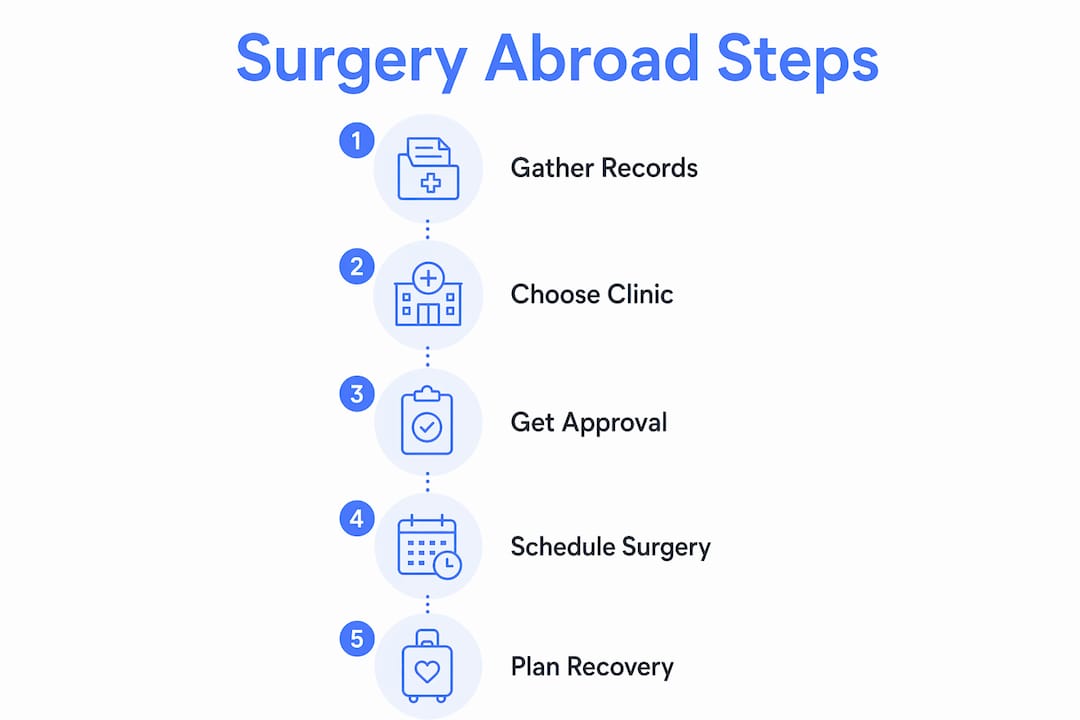
Step-by-step process to secure elective surgery quickly abroad
The sequence below reflects how most accredited providers structure the patient journey from first contact to discharge.
-
Send your inquiry. Submit your medical history, diagnosis, and imaging to the overseas provider. Most accredited facilities respond with a personalized assessment within 24 hours.
-
Complete any required pre-operative tests. Your provider will specify which blood panels, ECGs, or imaging studies you need. Many can be done at home and sent digitally.
-
Get a second opinion if needed. For complex procedures like spinal fusion or joint replacement, a second opinion from a local specialist adds a layer of safety before you commit.
-
Confirm your surgery date and pay the deposit. Once your assessment clears, lock in the date. Reputable providers issue a written treatment plan at this stage.
-
Arrange flights and accommodation. Many providers offer guidance on nearby hotels or partner accommodations. Book flexible tickets where possible to allow for minor scheduling shifts.
-
Plan a rest day on arrival. Arriving the day before your pre-operative appointment reduces jet lag effects and gives your body time to adjust before anesthesia.
-
Undergo the procedure at the accredited facility. Your chosen surgeon performs the operation under the same protocols required by JCI or Temos standards.
-
Stay hospitalized as advised. Depending on the procedure, inpatient stays typically run 3–7 days. Discharge happens only when your surgical team confirms you are stable.
| Procedure type | Typical inquiry-to-surgery timeline | Inpatient stay |
|---|---|---|
| Hip or knee replacement | 2–4 weeks | 3–5 days |
| Bariatric surgery | 2–6 weeks | 2–4 days |
| Spinal surgery | 3–6 weeks | 4–7 days |
| Cosmetic procedures | 1–3 weeks | 1–3 days |
| Dental implants | 1–2 weeks | Outpatient |
Pro Tip: Ask your provider for a named patient coordinator. Having one point of contact for scheduling, documentation, and logistics cuts confusion and speeds up the process significantly.
How to minimize elective surgery downtime abroad
Recovery management is where most medical tourists make avoidable mistakes. Cutting your stay short to save on accommodation costs is the most common error, and it carries real clinical risk.
-
Stay in destination for at least 3–7 days post-surgery. Most complications appear in the first 3–7 days after the procedure. Remaining locally during this window allows your surgical team to intervene quickly if needed.
-
Delay long-haul flights. Avoid flights over four hours for roughly four weeks after surgery to reduce deep vein thrombosis risk. Confirm the exact restriction with your operating surgeon, since orthopedic and abdominal procedures carry different timelines.
-
Get written aftercare instructions before discharge. Your provider should give you a document covering wound care, medication schedules, warning signs, and emergency contact numbers. Do not leave the facility without it.
-
Arrange local follow-up care before you travel. A soft landing with local follow-up care at home is a success factor many patients overlook. Book a post-operative appointment with your home GP or a local clinic before you fly out, not after you return.
-
Buy specialized medical travel insurance. Standard travel policies exclude elective procedure complications. Specialized medical travel insurance plans cover exactly these scenarios, including emergency evacuation and extended hospital stays abroad.
-
Keep all records accessible. Carry printed copies of your surgical report, discharge summary, and medication list. Digital copies on your phone are useful, but paper backups matter when you are in transit.
“Rushing the return flight is the single most preventable cause of post-operative complications in medical tourists. The cost of one extra night in a hotel is a fraction of the cost of treating a blood clot at home.”
Pro Tip: Set a calendar reminder for your follow-up appointment at home before you board your return flight. Patients who pre-schedule follow-ups are far more likely to attend them.
Examples of elective procedures done quickly abroad
Certain surgical categories consistently attract patients seeking faster access. The procedures below represent the most common fast-track surgery options overseas, along with realistic wait time comparisons.
Orthopedic surgery
Hip and knee replacements are available within 2–4 weeks at accredited orthopedic centers in several countries, compared to wait times that can stretch beyond a year on some domestic lists. Shoulder surgery follows a similar pattern, with scheduling windows of 3–6 weeks at specialist facilities. The best countries for orthopedic surgery abroad combine high surgical volume with strong rehabilitation infrastructure, which matters as much as the operation itself.
Bariatric and cosmetic procedures
Bariatric surgery, including gastric sleeve and gastric bypass, is one of the most common reasons patients pursue quick medical travel. Scheduling windows of 2–6 weeks are typical at accredited bariatric centers. Cosmetic procedures such as facelifts, rhinoplasty, and body contouring often have even shorter lead times of 1–3 weeks, since they carry fewer pre-operative requirements.
Spinal and dental surgery
Spinal procedures, including disc replacement and spinal fusion, are available within 3–6 weeks at specialist centers. Patients researching spinal surgery options abroad should confirm that the facility has a dedicated neurosurgery or orthopedic spine unit rather than a general surgical ward. Dental implants and full-mouth restorations are the fastest category overall, with many patients completing treatment in a single trip of 5–10 days.
- Fertility treatments, including IVF, are available with shorter scheduling delays at accredited reproductive medicine clinics in several European and Middle Eastern countries.
- Cataract surgery and other ophthalmologic procedures can often be scheduled within days at high-volume specialist centers.
- Cardiac procedures require the most rigorous pre-operative evaluation and carry longer lead times even abroad, typically 4–8 weeks minimum.
Key Takeaways
Getting surgery faster abroad is achievable and safe when patients prioritize accreditation, plan total costs honestly, and organize aftercare before they travel.
| Point | Details |
|---|---|
| Accreditation first | Choose JCI or Temos accredited facilities and verify surgeon credentials independently. |
| Total cost planning | Budget for flights, accommodation, insurance, and home follow-up, not just the procedure fee. |
| Stay post-surgery | Remain in destination for at least 3–7 days to cover the early complication window. |
| Flight restrictions | Avoid flights over four hours for roughly four weeks after surgery to reduce DVT risk. |
| Local aftercare | Book a home follow-up appointment before you fly out, not after you return. |
What I’ve learned from helping patients access surgery abroad
Patients come to me after months, sometimes years, on a waiting list. They are frustrated, and that frustration makes them vulnerable to the wrong kind of urgency. The biggest mistake I see is choosing a provider based on the shortest timeline or the lowest price rather than the strongest credentials. A two-week wait at an unaccredited facility is not a win. It is a gamble.
The patients who do best are the ones who treat this like a project, not a panic. They gather their records early. They ask hard questions about surgeon volume and complication rates. They book their home follow-up before they leave. These are not complicated steps, but they require a mindset shift: you are not just escaping a wait list, you are managing your own healthcare.
Coordination is where most patients underestimate the complexity. Organizing appointments, translating records, arranging accommodation near the clinic, and lining up aftercare at home involves more moving parts than a typical vacation. Patients who use a dedicated coordination service consistently report less stress and fewer logistical problems than those who manage everything independently. That is not a sales point. It is a pattern I have observed repeatedly.
My honest advice: give yourself more time than you think you need for research, and less urgency than you feel. The right facility will still be available in three weeks. The wrong one will always seem available immediately.
— Saher
Theratravel’s network for faster surgery abroad
Theratravel connects patients facing long wait lists with a curated network of accredited international clinics that specialize in fast-track elective procedures. Every clinic in the network holds recognized accreditation, and every patient receives a personalized treatment plan covering the procedure, travel logistics, and aftercare coordination.

Patients can use the NHS waiting list calculator to estimate their current domestic wait time and compare it against realistic overseas scheduling windows. From there, requesting a personalized procedure quote takes minutes and returns a detailed cost breakdown within 24 hours. Theratravel’s coordination team handles the logistics between inquiry and discharge, so patients focus on recovery, not paperwork. Browse Theratravel’s clinic network to see the full range of accredited facilities and procedure specializations available.
FAQ
How quickly can I get surgery abroad?
Most accredited overseas providers schedule elective procedures within 2–6 weeks of receiving your medical records and completing your assessment. Timelines vary by procedure complexity and destination.
Is surgery abroad as safe as surgery at home?
Surgery at JCI or Temos accredited facilities meets internationally recognized safety standards. Choosing an accredited surgeon and facility, then arranging local home support, forms the foundation of safe international surgical care.
What are the hidden costs of getting surgery abroad?
Hidden costs include extended accommodation for the recovery period, specialized medical travel insurance, return follow-up care at home, and any additional tests required before or after the procedure.
When can I fly home after surgery abroad?
Avoid flights over four hours for roughly four weeks post-surgery to reduce blood clot risk. Your operating surgeon will give you a procedure-specific clearance date before discharge.
Do I need to tell my home doctor before getting surgery abroad?
Yes. Informing your home GP or specialist before finalizing plans protects your continuity of care and prevents potential issues with your domestic health insurance coverage.
Recommended
Related posts

Overseas Hospital Room Standards: What Patients Need to Know

Why Overseas Healthcare Quality Improves for Surgery Patients
