


How Families Navigate Overseas Surgery: 2026 Guide

International medical travel is defined as the practice of crossing national borders to receive planned surgical care, typically to access faster scheduling, lower costs, or procedures not available domestically. Families navigating overseas surgery must coordinate medical documentation, travel logistics, companion support, and post-operative follow-up across two healthcare systems simultaneously. NHS waiting lists for procedures like pediatric scoliosis correction or cardiac surgery can stretch 12–18 months. That delay has real consequences for children’s development and adults’ quality of life. This guide covers every stage of the process, from choosing a hospital to budgeting for a companion’s three-week stay abroad.
Why do families choose overseas surgery?
The most direct reason families choose overseas treatment is time. Waiting lists in public healthcare can run 12–18 months, while international centers in countries like India and Thailand schedule surgeries within 2–4 weeks. For a child with progressive scoliosis or a parent awaiting a hip replacement, that gap is not a minor inconvenience. It is the difference between manageable and permanent damage.

Cost is the second major driver. Theratravel reports that overseas procedures can cost up to 60% less than equivalent UK prices. That saving covers not just the surgery itself but often the entire family’s travel and accommodation as well.
Families also travel abroad to access procedures that domestic systems classify as low priority or experimental. Certain spinal decompression techniques, pediatric cardiac interventions, and orthopedic reconstructions are performed routinely at high-volume international centers but face long queues or funding restrictions at home.
The risks are real and worth naming directly:
- Travel fitness: A patient must be stable enough to fly before and after surgery. Long-haul flights increase deep vein thrombosis risk post-operatively.
- Follow-up gaps: Home country physicians may be unfamiliar with the surgical technique used abroad, complicating post-discharge care.
- Communication barriers: Language differences can affect consent, discharge instructions, and emergency communication.
- Insurance exclusions: Standard travel insurance often excludes complications from elective procedures abroad. Families bear full financial responsibility without a specialized policy.
Weighing these risks against the benefits requires honest conversations with both the overseas surgical team and the family’s home physician. The goal is not to minimize risk but to manage it with full information.
How to prepare a child or family member for surgery abroad
Preparation for overseas surgery follows a clear sequence. Skipping steps creates legal, medical, or logistical problems that are far harder to fix once you are abroad.
- Gather and translate medical records. Collect imaging, lab results, surgical history, and current medications. Have them translated by a certified medical translator, not a general language service. Errors in dosage or diagnosis history can affect anesthesia planning.
- Secure legal consent. Medical tourism requires written consent from both parents for a child to undergo surgery abroad. If one parent stays home, a notarized consent letter is required. Confirm the specific format required by the destination country’s hospital.
- Consult the home physician. Ask your GP or specialist to confirm the patient is fit to travel and to document any contraindications. This protects the family legally and gives the overseas team critical context.
- Review vaccinations and health requirements. Some destinations require proof of specific vaccinations. Check requirements at least six weeks before departure to allow time for any necessary immunizations.
- Purchase specialized travel insurance. Standard policies exclude elective surgery complications. Look for policies that explicitly cover post-operative emergencies and medical repatriation. Awareness of these specialized products remains low, so ask your insurer directly.
- Prepare emotionally. Children need age-appropriate explanations of what will happen. Parents need to acknowledge their own anxiety. Suppressing it does not help; naming it does.
Pro Tip: Request an international patient coordinator from the hospital before you book. International patient coordinators handle scheduling, translation, airport pickup, and accommodation advice. Having one contact for all logistics reduces the cognitive load on the family significantly.
Emotional preparation is not a soft add-on. Parental burnout during medical travel is a documented risk. Parents who arrive exhausted make worse decisions and provide less effective support to the patient.
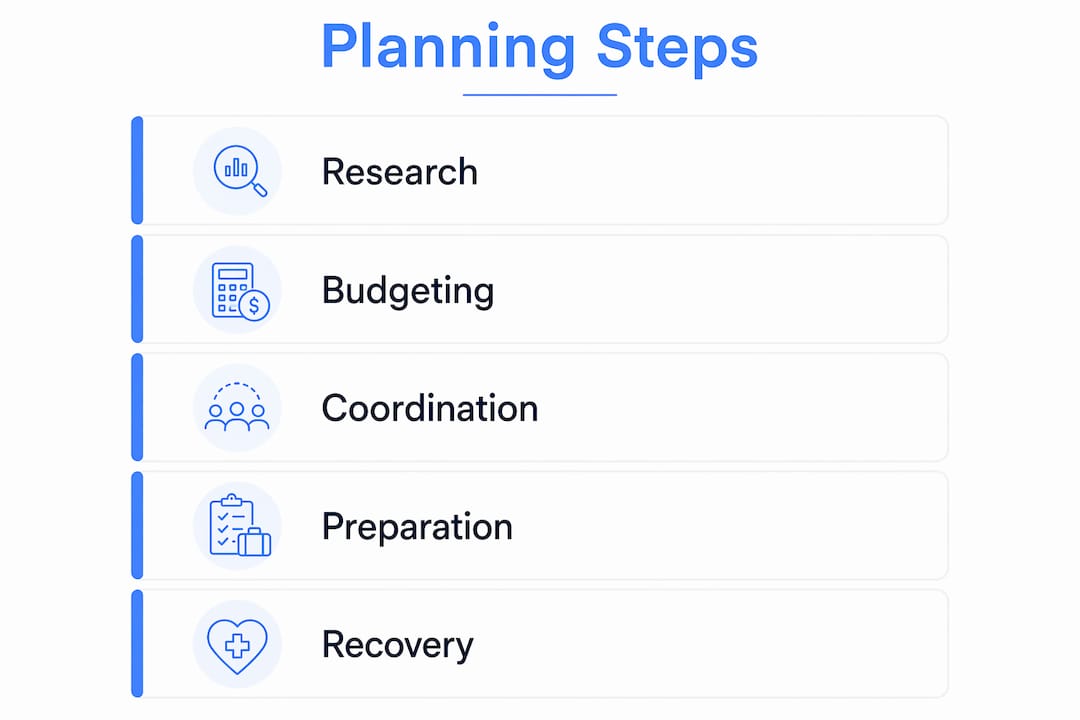
What does financial and logistical planning look like?
Families consistently underestimate the total cost of accompanying a patient through overseas surgery. The surgery quote covers the procedure. It does not cover the weeks surrounding it.
A realistic companion budget for a 14–21 day stay abroad includes approximately $1,200 for round-trip flights, $500 for food, and $150–$300 per day for accommodation. Some medical guesthouses charge as little as $25–$60 per day and are located within walking distance of the hospital. That option is worth researching early because availability is limited.
Recovery timelines extend beyond the hospital stay. Parents often underestimate the need for recovery buffers of 1–2 weeks beyond medical clearance before traveling home. Post-operative complications, slower healing, or a single abnormal lab result can delay discharge. Building that buffer into the budget and the work leave plan prevents a financial crisis at the worst possible moment.
Logistical planning covers several practical areas:
- Airport and hospital transfers: Confirm whether the hospital provides pickup or whether you need to arrange private transport. Some facilities include this in their international patient package.
- Accommodation proximity: Staying within 15 minutes of the hospital matters when a complication arises at 2:00 AM.
- Communication tools: A local SIM card or an international data plan is not optional. You need reliable contact with the surgical team and with family at home.
- Companion rotation: For longer stays, consider whether a second family member can relieve the primary companion for a few days. Caregiver fatigue affects judgment.
Use a surgery cost comparison guide to build a full picture of expenses before committing to a destination. Hidden costs, including pre-admission tests, post-operative medications, and discharge documentation fees, add up quickly. Theratravel’s guide on hidden costs in surgery quotes breaks down what to look for line by line.
How do you evaluate quality and safety in overseas hospitals?
Quality evaluation is the step families most often rush. A hospital’s website looks professional everywhere. The criteria that actually predict outcomes are specific and verifiable.
For pediatric surgery, the non-negotiable requirements are:
- A dedicated pediatric department with pediatric-trained staff, not adult wards that occasionally treat children.
- Pediatric-trained anesthesiologists. Pediatric anesthesia differs substantially from adult protocols. Proper dosing and monitoring reduce perioperative risks in ways that adult-trained anesthesiologists are not equipped to replicate.
- A pediatric ICU with child-sized equipment. Adult ICU equipment is not a safe substitute in an emergency.
- Case volume minimums of 50 procedures yearly for the specific procedure. Volume correlates directly with outcome quality.
Joint Commission International (JCI) accreditation is the most widely recognized international hospital quality standard. JCI-accredited hospitals meet defined benchmarks for patient safety, infection control, and care protocols. Accreditation does not guarantee a perfect outcome, but it confirms that the facility operates to a documented standard.
Ask the hospital directly for outcome data on the specific procedure. Reputable centers publish complication rates and revision surgery rates. If a hospital cannot or will not provide this data, that is a clear signal to look elsewhere.
Pro Tip: Request bilingual discharge summaries and operative reports before you leave the hospital. Bilingual discharge documentation is the single most effective tool for ensuring your home country physician can continue care without gaps. Many families arrive home with documents only in the local language, which delays follow-up significantly.
Verify the lead surgeon’s qualifications through the hospital’s medical board or the country’s national surgical registry. Board certification, fellowship training, and published case experience are all checkable facts. Choosing a reliable medical tourism provider requires the same due diligence you would apply to any major medical decision at home.
Key Takeaways
Families who plan overseas surgery with full financial, legal, and clinical preparation consistently achieve better outcomes than those who focus only on the procedure cost.
| Point | Details |
|---|---|
| Wait time reduction | International centers schedule surgeries within 2–4 weeks versus 12–18 months domestically. |
| Companion budget | Plan for $1,200 in flights, $500 in food, and $150–$300 per day for accommodation per companion. |
| Legal consent | Both parents must provide written, notarized consent for a child to undergo surgery abroad. |
| Recovery buffer | Add 1–2 weeks beyond medical clearance to the travel plan to cover potential complications. |
| Quality verification | Confirm JCI accreditation, pediatric case volumes, and bilingual discharge documentation before booking. |
What I’ve learned from families who’ve done this well
I have spoken with enough families who have gone through overseas surgery to recognize a pattern. The ones who manage it well are not the ones with the most money or the most medical knowledge. They are the ones who treat the trip like a project with a risk register, not an adventure with a hopeful outcome.
The detail that surprises most families is how much the companion’s experience shapes the patient’s recovery. A parent who is sleeping four hours a night, eating poorly, and managing every logistical problem alone will eventually make a mistake. That mistake might be a missed medication dose, a misunderstood discharge instruction, or simply not recognizing a warning sign because exhaustion has dulled their attention. Parental burnout is not a personal failing. It is a predictable outcome of an unsupported caregiver in an unfamiliar environment.
The families who do this well build in redundancy. They bring a second adult when possible. They use the hospital’s international patient coordinator for every logistical question instead of trying to solve problems independently. They keep a written log of medications, symptoms, and conversations with the surgical team. That log becomes invaluable when they return home and need to brief a GP who has never seen the operative report.
One more thing: do not leave the hospital without a clear plan for the first 72 hours at home. Who is the point of contact if a wound looks wrong? What are the fever thresholds that require emergency care? Which local hospital has the capacity to manage a post-operative complication from a procedure they did not perform? These questions have answers. Get them in writing before discharge.
— Saher
Theratravel’s support for families planning surgery abroad
Families who want to move from research to action need a starting point that is specific to their situation, not a generic list of hospitals.

Theratravel works with families facing NHS waiting lists to identify high-quality international facilities, provide transparent procedure quotes, and coordinate the logistics of traveling for surgery. The vetted international clinics on Theratravel’s platform meet defined standards for surgical volume, accreditation, and patient support services. Families can use the NHS waiting list calculator to benchmark their current domestic wait against international scheduling timelines. For a personalized cost estimate, the medical procedure quote tool provides a detailed breakdown with no obligation. Theratravel’s patient coordinators are available to answer questions and help families understand exactly what is included before any commitment is made.
FAQ
How long does overseas surgery typically take from start to finish?
Most families spend 3–5 weeks abroad when accounting for pre-operative assessments, the procedure itself, hospital recovery, and the recommended 1–2 week buffer before flying home.
What insurance do families need for surgery abroad?
Standard travel insurance excludes elective surgery complications. Families need a specialized policy that explicitly covers post-operative emergencies and medical repatriation back to their home country.
Is pediatric surgery abroad safe for young children?
Pediatric surgery abroad is safe when performed at hospitals with dedicated pediatric departments, pediatric-trained anesthesiologists, a pediatric ICU, and a minimum annual case volume for the specific procedure.
What documents does a child need for surgery in another country?
A child needs translated medical records, proof of vaccinations, valid travel documents, and a notarized consent letter from any parent who does not travel with the child.
How do families manage follow-up care after returning home?
The most effective approach is to obtain bilingual discharge summaries and operative reports before leaving the hospital abroad, then brief the home GP immediately upon return to establish a clear post-operative monitoring plan.
Recommended
Related posts

Overseas Hospital Room Standards: What Patients Need to Know

How to Get Surgery Faster Abroad: A Patient's Guide
