
Why Single Price Surgery Packages Are Better for Patients

Single price surgery packages, also called bundled payment models, are all-inclusive surgical pricing agreements that cover surgeon fees, anesthesia, facility costs, and follow-up care under one upfront price. These packages are better than traditional hospital billing because they eliminate surprise costs, reduce administrative overhead, and give patients complete financial clarity before they ever step into an operating room. Patients exploring affordable surgical options increasingly turn to flat rate surgery as a way to avoid the unpredictable billing that defines standard insurance-based care. Single price packages cost 40–60% less than traditional hospital pricing. That gap is large enough to make overseas surgery financially practical for patients on NHS waiting lists.
Why single price surgery packages are better than traditional billing
Traditional hospital billing splits your surgical costs across multiple separate invoices. You receive one bill from the surgeon, another from the anesthesiologist, a third from the facility, and sometimes additional charges for surgical supplies or post-op consultations. Each of those bills may interact differently with your insurance policy, creating gaps that land directly on you.

Single price surgery packages collapse all of those charges into one number you know before scheduling. The financial structure works because providers absorb administrative costs rather than passing them to patients. Insurance billing requires significant overhead: prior authorization teams, coding specialists, and claims processors all add cost without adding clinical value.
The savings are substantial. Bundled pricing reduces costs by 40–60% compared to traditional hospital pricing. That reduction comes directly from cutting the administrative layer out of the equation.
- Surgeon fees are included in the single price, with no separate billing
- Anesthesia is covered upfront, not billed as an independent service
- Facility and operating room costs are bundled into the quoted price
- Follow-up appointments are typically included, removing post-op billing surprises
- Extended stays for medical reasons are absorbed by the hospital, not charged to the patient, under fixed-price models
Pro Tip: Always ask the provider for a written breakdown confirming that anesthesia, facility fees, surgical supplies, and at least one follow-up visit are included in the quoted price. A low headline number that excludes anesthesia is not a true flat rate.
Does single price surgery improve quality and safety?
The financial model does more than cut costs. It actively improves surgical outcomes by realigning the incentives of everyone involved in your care.
Traditional fee-for-service billing rewards volume. More procedures mean more revenue. That structure creates a subtle but real pressure toward unnecessary surgeries. Fixed-price models remove that pressure entirely. Fixed-salary clinical staff in integrated surgical models reduce unnecessary surgeries by 50%. That figure reflects a fundamental shift in how clinical decisions get made.
Clinical pathway-based single payment policies reduce hospital expenses by 13.28% and lower surgical complication rates from 7.8% to 4.9%. That drop in complications is not cosmetic. Fewer complications mean shorter recoveries, fewer readmissions, and better long-term outcomes for patients.
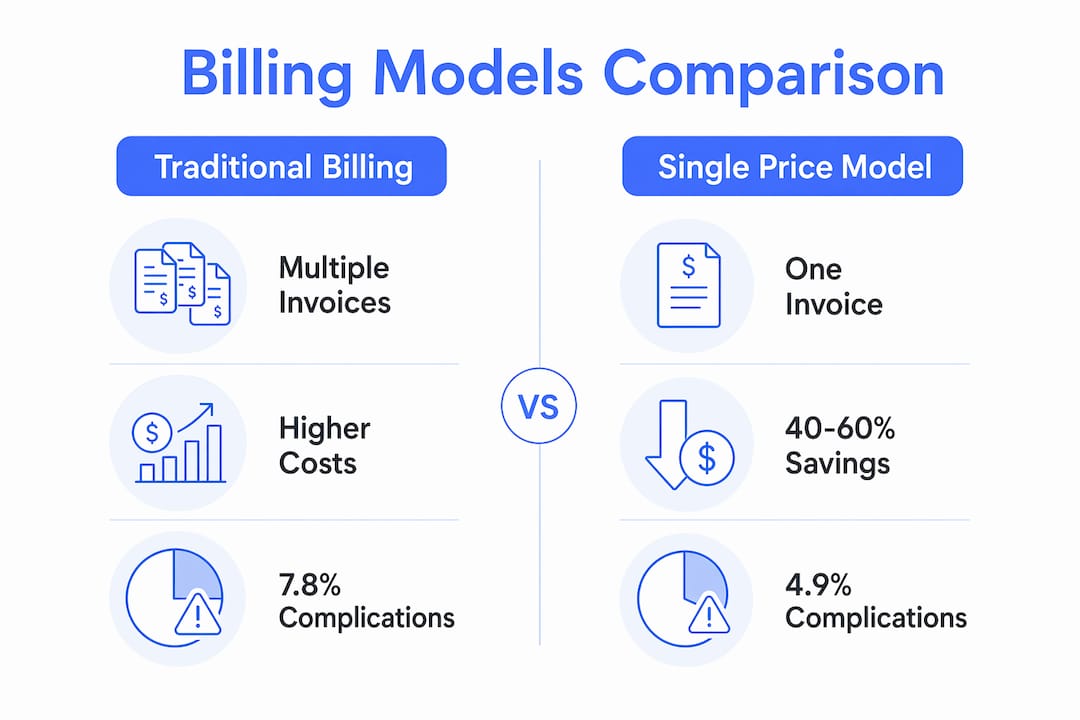
Bundled payment models also push providers to adopt minimally invasive techniques and structured post-operative protocols. When the hospital absorbs the cost of complications, it has a direct financial reason to prevent them. Optimized post-op pathways in fixed-price programs reduce average patient stays to as little as 1.2 days through proactive monitoring. Faster discharge with structured follow-up is safer than prolonged hospital stays when the clinical pathway is well-designed.
| Metric | Traditional billing model | Single price model |
|---|---|---|
| Surgical complication rate | 7.8% | 4.9% |
| Unnecessary surgery rate | Baseline | Reduced by 50% |
| Average hospital stay | Standard length | Reduced to ~1.2 days |
| Hospital expense per case | Baseline | Reduced by 13.28% |
The data points in one direction. When providers are paid a fixed amount to deliver a good outcome, they focus on delivering a good outcome.
How flat rate surgery simplifies your financial planning
The single biggest practical benefit of flat rate surgery is knowing your total cost before you commit. Surprise billing elimination is the primary advantage patients report, because it allows informed decisions with real financial predictability.
Traditional billing makes financial planning nearly impossible. You can ask for cost estimates, but those estimates rarely account for every billable item. Anesthesia is frequently billed separately by an independent provider who may be out of network even when your surgeon is in network. Surgical supply charges, pathology fees, and post-op imaging can appear weeks after your procedure.
Single price surgery packages replace that uncertainty with one invoice. You know the number. You can plan around it, save for it, or compare it against other options without guesswork. Patients using all-inclusive surgery packages consistently report that financial clarity reduces stress before and after surgery.
Removing insurance prior authorization also accelerates scheduling. When your surgery date depends only on medical need rather than insurer approval timelines, you get treated faster. For patients on NHS waiting lists, that difference can be measured in months.
Pro Tip: Before signing any surgical agreement, confirm in writing that the quoted price covers all diagnostics required before surgery, not just the procedure itself. Pre-operative blood work and imaging are common exclusions that inflate the final cost.
The table below shows how the two billing pathways differ in practice.
| Stage | Traditional billing | Single price billing |
|---|---|---|
| Pre-surgery cost estimate | Approximate, subject to change | Fixed, confirmed in writing |
| Insurance authorization | Required, adds weeks of delay | Not required |
| Number of invoices received | Multiple (surgeon, facility, anesthesia) | One |
| Surprise billing risk | High | None |
| Post-op follow-up billing | Separate charge | Included |
| Extended stay costs | Charged to patient | Absorbed by provider |
Who benefits most from single price surgery packages?
Not every patient is an equally strong candidate for flat rate surgery. The model delivers the greatest value in specific financial and clinical situations.
Patients with high insurance deductibles often pay more out of pocket under traditional billing than they would under a single price package. If your deductible is £3,000 or higher, a bundled price that covers everything may cost less in total. Uninsured patients benefit most directly, since they face the full itemized rate under traditional billing with no negotiated discount.
Elective procedures are the clearest fit. Orthopedic surgery, hernia repair, cataract removal, and spinal procedures are commonly offered under bundled pricing. These are also the procedures with the longest NHS waiting times, which makes the scheduling advantage especially relevant.
Patients with mobility-limiting conditions benefit from the faster access that comes with overseas surgery approval processes that bypass insurance authorization entirely. Waiting six months for a knee replacement while in daily pain is a real cost that does not appear on any invoice.
Consider a single price package if you match any of these criteria:
- You have a high deductible or are uninsured
- You are on an NHS waiting list for an elective procedure
- You need surgery within a defined timeframe for work or mobility reasons
- You want to compare total surgical costs across providers or countries
- You have had a previous experience with surprise billing after surgery
Traditional insurance billing may still be preferable if your procedure is complex, requires unpredictable specialist involvement, or if your insurer covers the full cost with no meaningful out-of-pocket exposure. The model is not universal, but for the majority of elective surgical patients, the single price structure is the better financial choice.
Key Takeaways
Single price surgery packages are better than traditional billing because they reduce total costs by 40–60%, eliminate surprise invoices, lower complication rates, and give patients a confirmed price before surgery begins.
| Point | Details |
|---|---|
| Cost savings are significant | Bundled pricing cuts total surgical costs by 40–60% compared to traditional hospital billing. |
| Complications drop under fixed pricing | Clinical pathway models lower complication rates from 7.8% to 4.9% by aligning provider incentives. |
| One invoice replaces many | Surgeon, anesthesia, facility, and follow-up care are covered under a single upfront price. |
| Scheduling is faster | Removing insurance prior authorization means surgery is scheduled on medical need alone. |
| Best fit for elective procedures | Patients with high deductibles, NHS delays, or elective needs gain the most from flat rate surgery. |
The shift I’ve watched happen in surgical pricing
I’ve spent years watching patients navigate the gap between what surgery costs on paper and what it costs in reality. The two numbers are rarely the same under traditional billing. Patients receive an estimate, agree to proceed, and then spend months reconciling invoices they never anticipated.
What strikes me about the flat rate model is not just the savings. It’s the psychological shift. Patients who know their total cost upfront make better decisions. They ask sharper questions. They compare options more confidently. They show up to surgery less anxious, which genuinely affects recovery.
The clinical data on complication rates supports what I’ve observed anecdotally. When providers are not rewarded for volume, they stop performing procedures that don’t need to happen. That is a structural fix, not a cultural one, and it is more reliable for that reason.
The technology supporting this model is also maturing. Digital care coordination, remote post-op monitoring, and structured discharge protocols like the “Magic Discharge” pathway used in some fixed-price programs make shorter hospital stays clinically safe rather than just financially convenient. The model works because the infrastructure now supports it.
My advice to any patient considering surgery abroad or privately: ask for a written all-inclusive quote before anything else. If the provider cannot give you one, that tells you something important about how they manage costs and outcomes.
— Saher
Theratravel’s approach to upfront surgical pricing
Patients who want the financial clarity of a single price model without the complexity of arranging it independently have a direct path forward with Theratravel.

Theratravel provides all-inclusive surgery packages that cover your procedure, travel coordination, accommodation, and aftercare under one confirmed price. Every package is built around your specific procedure and medical profile, so the quote you receive reflects your actual care needs. Theratravel works with premium accredited clinics that operate on fixed-price models, meaning no surprise invoices after you return home. Patients facing NHS delays can access the same quality of surgical care at up to 60% less than UK private rates. Request a personalized procedure quote and get a confirmed price for your surgery today.
FAQ
What does a single price surgery package include?
A single price surgery package covers surgeon fees, anesthesia, facility costs, and follow-up care under one upfront price. All-inclusive quotes should also include pre-operative diagnostics and any medically necessary extended stay.
How much can I save with flat rate surgery?
Bundled surgical pricing typically costs 40–60% less than traditional hospital billing. The savings come from reduced administrative overhead and the elimination of separate specialist invoices.
Does single price surgery mean lower quality care?
No. Clinical pathway models using fixed payment structures actually lower complication rates from 7.8% to 4.9% by aligning provider incentives with patient outcomes rather than procedure volume.
Can I get surgery faster with a single price package?
Yes. Removing insurance prior authorization means scheduling is based on medical need alone, which cuts wait times significantly compared to insurance-dependent pathways.
What should I verify before accepting a single price quote?
Confirm in writing that anesthesia, facility fees, surgical supplies, and at least one post-op visit are included. Hidden cost risks arise when headline prices exclude standard components like anesthesia or pre-operative imaging.
Recommended
Related posts

Veneers Abroad: 2026 Cost Guide (and What to Watch For)

Is It Safe to Get Dental Implants Abroad? An Honest 2026 Guide