
What Is Medical Tourism? A 2026 Patient Guide

Medical tourism is defined as traveling to another country specifically to receive medical care, whether for elective surgery, specialized treatment, or procedures that are unavailable or unaffordable at home. The global medical tourism market is projected to reach $755 billion by 2034, a figure that reflects just how many patients worldwide are choosing to cross borders for care. Joint Commission International (JCI) accreditation has become the gold standard for hospitals competing for international patients. Theratravel helps UK patients access this global network at costs up to 60% lower than domestic prices.
What is medical tourism, and how does it work?
Medical tourism is the practice of leaving your home country to receive clinical treatment abroad. The industry term is “international patient services,” though “medical tourism” is the phrase most patients use when searching for options. The two terms describe the same core activity: coordinating travel, accommodation, and medical care in a foreign country.
Medical tourism differs from wellness tourism in one critical way. Wellness travel covers spas, retreats, and preventive health programs. Medical tourism covers clinical procedures that require a diagnosis, pre-operative clearance, a surgeon, and post-operative monitoring. Conflating the two leads patients to underestimate the planning and medical oversight required.
A typical medical tourism package includes pre-treatment consultations, the hospital stay, travel logistics, and recovery arrangements. Treatment packages are increasingly all-inclusive, covering airport transfers, interpreter services, and follow-up appointments. Theratravel structures its packages exactly this way, so patients arrive knowing every step is already coordinated.

Why do patients choose medical tourism?
Three factors drive the vast majority of medical tourism decisions: cost, access, and specialization. Patients pursue medical tourism to overcome healthcare gaps such as long wait times, limited local expertise, and high treatment costs. Each factor operates independently, meaning a patient might travel abroad even when cost is not the primary concern.
The access problem is acute in countries with public healthcare systems. NHS waiting lists in the UK have pushed tens of thousands of patients to look abroad for timely surgery. A patient waiting 18 months for a knee replacement faces real physical and economic consequences. Traveling abroad for the same procedure, performed within weeks, is not a luxury choice. It is a practical response to a system under pressure.
Cost advantages are equally compelling:
- Orthopedic surgeries abroad can cost a fraction of private UK rates
- Dental implants in countries like Turkey or Hungary cost significantly less than in Western Europe
- Fertility treatments such as IVF are often priced well below UK clinic rates
- Cosmetic procedures carry similar quality at substantially lower total cost
Medical tourism is not just a cost-saving measure. It is a systemic adaptation to healthcare access gaps worldwide, driven by capacity constraints and demand for specialized care.
Private insurance increasingly covers international procedures, and several countries have bilateral agreements that enable cross-border reimbursement. That shift has made medical travel a realistic option for a much broader group of patients, not just those paying entirely out of pocket.
What types of treatments do medical tourists seek?
Commonly pursued treatments include cosmetic surgeries, dental procedures, fertility treatments, organ transplantation, orthopedic operations, and cardiovascular care. Patients seek these due to local unavailability, high costs, or long wait times. The range is wider than most people expect.
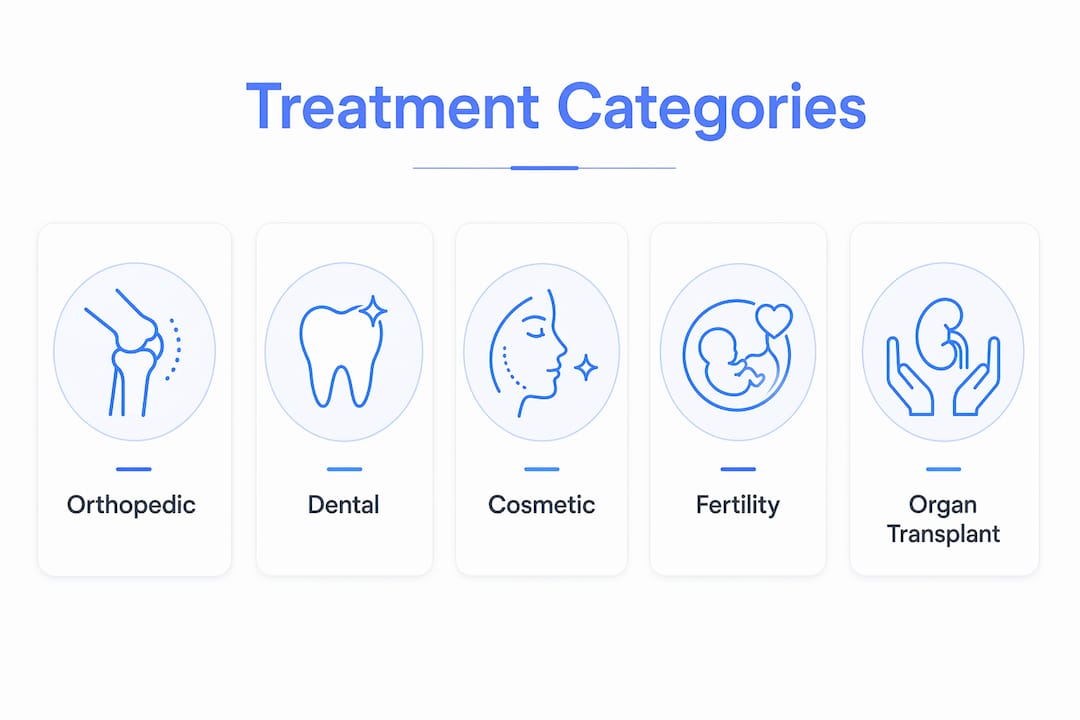
Here is a breakdown of the most frequently requested procedure categories:
| Treatment Category | Common Procedures |
|---|---|
| Orthopedic | Hip replacement, knee replacement, spinal surgery |
| Cardiovascular | Bypass surgery, valve replacement, angioplasty |
| Dental | Implants, veneers, full-mouth restoration |
| Fertility | IVF, egg donation, embryo transfer |
| Cosmetic | Rhinoplasty, liposuction, breast augmentation |
| Oncology | Targeted therapy, proton beam treatment |
Elective surgeries dominate the market, but complex and medically necessary procedures are a growing share of outbound medical tourism. Patients traveling for cardiac bypass or cancer treatment are not making lifestyle choices. They are responding to clinical realities at home.
Wellness and preventive care fall outside this category. A patient attending a detox retreat is not a medical tourist by the clinical definition. That distinction matters because clinical medical tourism demands specific pre-trip medical clearances, risk assessments, and post-treatment monitoring that wellness travel does not require.
Pro Tip: Request a full written treatment plan from any overseas provider before you book flights. A reputable clinic will provide this without hesitation. If they cannot, treat that as a warning sign.
You can review what medical tourism packages typically include to understand what a well-structured offer should look like before you compare providers.
How can patients ensure safety and quality in medical tourism?
Safety in medical tourism depends on the rigorous vetting of hospitals and surgeons, not on the destination country itself. A country’s reputation does not guarantee the quality of a specific clinic. Patients who skip this step take on real risk.
Follow these steps to vet any overseas provider:
- Confirm JCI accreditation. Joint Commission International is the most recognized international hospital accreditation body. Accredited hospitals meet defined standards for patient safety, infection control, and clinical outcomes.
- Research the surgeon’s credentials. Ask for board certification, years of experience in the specific procedure, and volume data. High-volume surgical centers abroad often produce more consistent outcomes than lower-volume providers at home.
- Use a qualified medical travel facilitator. Facilitators vet clinics, coordinate pre-operative testing, manage logistics, and maintain continuity of care between foreign providers and your local doctors. Self-arranged medical tourism frequently lacks proper aftercare follow-up.
- Plan your aftercare before you travel. Confirm that your home-country GP or specialist will manage your recovery. Get written post-operative instructions in your language before you leave the hospital abroad.
- Read the contract carefully. Understand what happens if a complication arises. Know who is responsible for revision surgery costs and how disputes are handled.
The role of accredited overseas hospitals in protecting patient outcomes cannot be overstated. Accreditation is not a marketing badge. It is a documented commitment to clinical standards that any patient can verify independently.
Pro Tip: Ask your facilitator for the name and direct contact of the surgeon performing your procedure. If the facilitator cannot or will not provide this before you pay a deposit, choose a different facilitator.
A good medical travel facilitator acts as your advocate throughout the entire process, from initial inquiry to post-procedure follow-up. That advocacy is the single most important factor separating safe medical tourism from risky self-arranged travel.
What does the global medical tourism market look like in 2026?
The medical tourism market is one of the fastest-growing sectors in global healthcare. Valued at $207 billion by 2027 and projected to reach $755.39 billion by 2034, the market reflects a structural shift in how patients access care. That growth is not speculative. It tracks real patient volumes and expanding hospital infrastructure in destination countries.
Patient flows have reversed from historical patterns. Modern medical travel primarily moves from developed countries to specialized international hubs that provide high-tech care at lower cost. Malaysia tops medical tourism rankings due to its combination of clinical expertise and international hospitality standards. Turkey, Thailand, India, and several Eastern European countries have built entire hospital networks around international patient services.
The shift is structural, not cyclical. Healthcare systems in developed countries face aging populations, rising costs, and constrained capacity. Medical tourism fills the gap that domestic systems cannot close.
| Destination Region | Competitive Advantage |
|---|---|
| Southeast Asia | JCI-accredited hospitals, lower labor costs, English-speaking staff |
| Eastern Europe | Geographic proximity to Western Europe, dental and orthopedic specialization |
| Middle East | Advanced oncology and cardiac centers, growing infrastructure |
| South Asia | High-volume surgical centers, significant cost advantage |
Globalization and digital access have accelerated this trend. Patients can now research surgeons, read outcome data, and request quotes from international clinics without leaving home. That transparency has raised patient expectations and pushed destination hospitals to compete on quality, not just price.
Key Takeaways
Medical tourism is the most direct solution available to patients facing long wait times, high costs, or limited access to specialized care at home.
| Point | Details |
|---|---|
| Clear definition | Medical tourism means traveling abroad for clinical care, not wellness or preventive travel. |
| Three core drivers | Cost, access, and specialization each independently motivate patients to seek care abroad. |
| Accreditation is non-negotiable | JCI-accredited hospitals meet verified international safety and clinical standards. |
| Facilitators reduce risk | Professional facilitators vet clinics, coordinate logistics, and protect continuity of care. |
| Market growth is structural | The global market is projected to reach $755 billion by 2034, reflecting real patient demand. |
What I’ve learned after years of watching patients navigate medical tourism
Most patients approach medical tourism with one of two mindsets. Either they are desperate and will accept almost any offer, or they are so cautious that they talk themselves out of a genuinely good option. Neither mindset serves them well.
The patients who get the best outcomes share one habit: they treat the vetting process as seriously as the procedure itself. They ask hard questions about surgeon volume, accreditation status, and aftercare protocols. They do not book based on a website or a price alone.
The biggest misconception I see is that medical tourism is inherently riskier than staying home. That is not supported by the evidence. High-volume centers abroad often outperform lower-volume domestic providers on specific procedures. The risk is not in traveling. The risk is in traveling without proper vetting.
Aftercare is where most self-arranged medical tourism fails. Patients return home without a clear plan, and their local GP has no information about what was done or what to monitor. A good facilitator closes that gap before you board the plane. The role of aftercare in medical travel is not a secondary concern. It is part of the procedure.
My honest advice: use a facilitator, confirm JCI accreditation, and have your aftercare plan in writing before you travel. Those three steps eliminate the majority of risk that makes people hesitant about medical tourism in the first place.
— Saher
Theratravel: accredited clinics, real quotes, and no waiting
Theratravel connects UK patients with a network of premium accredited clinics that meet international safety standards, at costs up to 60% lower than UK private rates. Every package is built around the individual patient, covering treatment planning, travel, and aftercare coordination from start to finish.

Patients facing NHS delays can use the NHS Waiting List Calculator to see how long they are likely to wait at home versus how quickly they could be treated abroad. Those who are ready to move forward can request a personalized procedure quote directly through Theratravel. The process is straightforward, and the first step costs nothing.
FAQ
What is the medical tourism definition?
Medical tourism is the practice of traveling to another country to receive clinical medical care, including elective surgeries, dental procedures, fertility treatments, and complex operations. It differs from wellness tourism because it requires medical diagnosis, pre-operative clearance, and post-operative monitoring.
Is medical tourism safe?
Medical tourism is safe when patients choose JCI-accredited hospitals and experienced surgeons, and when they use a qualified facilitator to coordinate care. The risk increases significantly with self-arranged travel that lacks proper vetting and aftercare planning.
What is outbound medical tourism?
Outbound medical tourism refers to patients leaving their home country to receive treatment abroad, as opposed to inbound medical tourism where a country receives international patients. Most UK patients engaging in medical tourism are outbound travelers seeking faster or more affordable care.
What treatments are most common in medical tourism?
The most common treatments include orthopedic surgeries, dental procedures, cosmetic surgeries, fertility treatments such as IVF, and cardiovascular operations. Patients seek these due to high domestic costs, long wait times, or limited local availability.
How do I start planning medical tourism?
Start by identifying your procedure, then research JCI-accredited hospitals in your target destination. Work with a qualified medical travel facilitator to vet providers, coordinate logistics, and establish an aftercare plan with your home-country physician before you travel.
Recommended
Related posts

Veneers Abroad: 2026 Cost Guide (and What to Watch For)

Is It Safe to Get Dental Implants Abroad? An Honest 2026 Guide