


How Overseas Surgery Approval Works: 2026 Patient Guide

Overseas surgery approval is the formal process by which patients obtain the necessary permissions from insurers or health systems to undergo elective surgery abroad safely and legally. Understanding how overseas surgery approval works is the difference between a covered, well-coordinated procedure and an expensive, unsupported one. The process involves submitting medical records, securing insurer or health authority sign-off, verifying hospital accreditation, and arranging aftercare before you ever board a plane. Theratravel guides patients through each of these steps, helping them avoid the delays and documentation gaps that derail most self-managed attempts.
How does overseas surgery approval work step by step?
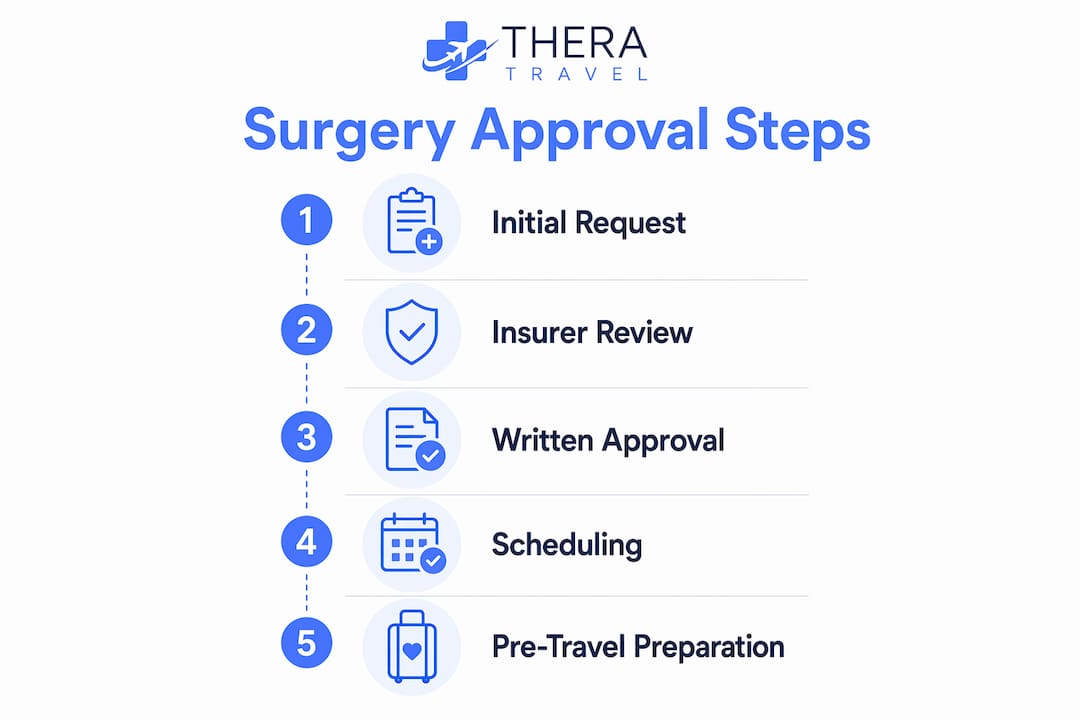
The international surgery approval process follows a defined sequence. Skipping any step creates gaps that insurers or overseas hospitals will flag, often at the worst possible moment.
-
Submit your medical records and referral documentation. Your GP or specialist provides a referral letter, recent imaging, blood work, and a diagnosis summary. Overseas hospitals require this package before they can assess your suitability. Hospitals review these documents and issue a preliminary treatment outline before you travel.
-
Request pre-approval from your insurer or health authority. Private insurers require a formal pre-authorization request that names the procedure, the overseas facility, and the treating surgeon. Without this step, your policy will not cover the cost. Submit the request in writing and keep a copy of every response.
-
Verify hospital accreditation and surgeon credentials. Accreditation bodies like Joint Commission International (JCI) set the global benchmark for hospital quality. Confirming that your chosen facility holds recognized accreditation protects you legally and medically. You can review overseas healthcare quality standards to understand what to look for.
-
Coordinate the treatment plan with the overseas clinic. The overseas surgeon reviews your records and proposes a treatment plan. This plan goes back to your insurer for final approval. Any mismatch between the proposed procedure and your pre-authorization request causes delays.
-
Receive formal written approval. Approval arrives as a written authorization from your insurer or health authority. This document specifies the procedure, the approved facility, and the coverage limits. Keep the original and bring a copy to your surgery.
Pro Tip: Request approval in writing even when a coordinator gives verbal confirmation. Verbal approvals are not binding and will not hold up with an insurer if a dispute arises.
Best international patient journeys set clear expectations about timelines, tests, and treatment plans before travel begins. Patients who receive a preliminary outline before departure report fewer surprises on arrival.

How does scheduling work once approval is secured?
Scheduling abroad surgical procedures after approval requires more planning than booking a domestic surgery. You are coordinating across time zones, healthcare systems, and travel logistics simultaneously.
Once your written approval is in hand, the overseas clinic assigns a surgery date based on surgeon availability and your recovery window. Most elective procedures require a minimum stay abroad to allow for pre-operative assessment and early postoperative monitoring. Planning your total time abroad before booking flights prevents costly last-minute changes.
Key scheduling considerations include:
- Pre-surgery consultation. Most accredited overseas hospitals conduct a telemedicine consultation before your arrival to confirm the treatment plan and answer questions. This replaces the in-person pre-operative appointment and saves you an extra trip.
- Surgery date and hospital stay. Book your surgery date first, then work backward to set your arrival date. Arriving at least one day before surgery gives you time to rest and complete any on-site pre-operative tests.
- Recovery time abroad. Your surgeon specifies the minimum number of days you must remain in the destination country before flying. Ignoring this window increases your risk of complications during the flight.
- Travel documents and medical travel insurance. Confirm that your travel insurance policy covers planned surgical procedures. Standard travel insurance excludes pre-planned medical treatment unless you purchase a specialist policy.
- Clear timelines for all parties. Share your full schedule, including arrival, surgery, and departure dates, with both your overseas surgeon and your home GP. This prevents communication gaps during your recovery.
Pro Tip: Ask your overseas clinic for a written patient timeline document. It should list every appointment, test, and discharge milestone so you can track your progress and share it with your local doctor.
How is overseas postoperative care arranged?
Postoperative care is the most frequently underestimated part of getting surgery abroad. Patients focus on the surgery itself and treat aftercare as an afterthought. That approach creates real risk.
Structured post-operative follow-up reduces complication rates by 30–40%, bridging care gaps between overseas and home providers. That figure reflects what happens when patients have scheduled check-ins versus no formal follow-up plan.
Discharge documentation
Your overseas surgeon must provide two documents before you leave: a formal discharge summary and a detailed operative note. The discharge summary covers your diagnosis, procedure, and immediate aftercare instructions. The operative note goes further. Operative notes contain ICD-10 codes and internal suture brands, giving your local doctor the technical detail needed to manage follow-up and complications safely. A discharge summary alone is not enough.
Telemedicine follow-up schedule
Telemedicine follow-up consultations after surgery abroad typically last 15–30 minutes and cost $30–$100 each. The recommended schedule runs at 2 weeks, 6 weeks, and 3 months post-op. These sessions allow your overseas surgeon to review wound photos, imaging, and blood results remotely. Missing these appointments leaves complications undetected until they become serious.
Bridging communication between providers
Facilitating a direct introduction between your overseas surgeon and your local GP builds trust and continuity in postoperative care. Send your GP the operative note and discharge summary before your first appointment back home. Ask your overseas clinic to copy your GP on telemedicine follow-up notes.
| Aftercare element | What it covers |
|---|---|
| Discharge summary | Diagnosis, procedure performed, and immediate care instructions |
| Operative note | ICD-10 codes, implant details, and surgical technique for local doctors |
| Telemedicine follow-ups | Remote check-ins at 2 weeks, 6 weeks, and 3 months post-op |
| Escalation protocol | Specifies who is responsible financially and logistically if complications arise |
| Prescription management | Medication supply and instructions bridging overseas and home care |
An effective aftercare pathway includes scheduled remote consultations at 48 hours, 1 week, 2 weeks, and 1 month, plus a documented escalation protocol. The escalation protocol specifies financial and logistic responsibilities if complications arise, which protects both you and your providers.
What documents and special approvals do you need for travel?
Beyond the surgical approval itself, overseas surgery requires a separate layer of travel-specific clearance. Most patients overlook this until the day before departure.
The critical documents and approvals you need include:
- Fit-to-fly letter. A signed fit-to-fly letter from your overseas surgeon confirming no signs of deep vein thrombosis (DVT) is generally mandatory for travel after surgery. Airlines and insurers both require it. Request this letter before your discharge appointment.
- Medical travel insurance confirmation. Standard travel policies exclude planned surgery. Confirm in writing that your policy covers the specific procedure, the destination country, and any complications requiring extended stay.
- Home country regulatory paperwork. Some procedures require documentation for customs, particularly if you are traveling with prescription medications or medical devices like implants.
- Overseas facility accreditation certificate. Carry a copy of your hospital’s JCI or equivalent accreditation certificate. Some insurers require it as part of their claims process.
- Patient checklist from your coordinator. A written checklist from your overseas clinic or medical travel coordinator reduces the chance of missing a document. Confirm local follow-up care availability before you travel, because NHS or GP support after overseas treatment is not guaranteed.
The most common pitfall patients encounter is assuming their home GP will automatically provide follow-up care after overseas surgery. Many GPs are willing to help but need the operative note and discharge summary in advance. Provide these documents before your first post-surgery appointment, not during it.
Key Takeaways
Overseas surgery approval is a structured, multi-step process that requires documented insurer sign-off, verified hospital accreditation, and a formal aftercare plan before and after your procedure.
| Point | Details |
|---|---|
| Approval requires written sign-off | Verbal confirmation from coordinators does not bind insurers; always get written authorization. |
| Operative notes beat discharge summaries | ICD-10 codes and implant details in operative notes let local doctors manage complications safely. |
| Structured aftercare cuts complication risk | Scheduled telemedicine follow-ups at 2 weeks, 6 weeks, and 3 months reduce complications by 30–40%. |
| Fit-to-fly clearance is mandatory | Airlines and insurers require a signed DVT clearance letter from your overseas surgeon before you fly home. |
| Local follow-up is not automatic | Confirm GP or NHS follow-up availability before travel and share your operative note in advance. |
What I’ve learned about overseas surgery approval that most guides miss
Most articles on this topic treat approval as a single checkbox. In practice, it is a chain of handoffs, and the weakest link is almost always the transition from overseas care back to home care.
Patients spend weeks preparing for surgery and almost no time preparing their local GP for what comes next. The overseas surgeon does excellent work, the patient recovers well in the clinic, and then they arrive home with a discharge summary their GP cannot fully interpret. The operative note, with its ICD-10 codes and implant specifics, sits in a patient portal no one told the GP to access. That gap is where complications become serious.
The second thing most guides miss is the escalation protocol. Patients assume that if something goes wrong after they return home, the overseas clinic will handle it. That assumption is wrong unless it is written into a formal agreement before surgery. A documented escalation protocol that names financial and logistic responsibilities is not bureaucratic paperwork. It is the document that determines whether a complication costs you £500 or £15,000.
My honest recommendation: treat the approval process as two separate projects. The first is getting approved for surgery. The second is building a care handover plan that your home GP can actually use. Both require the same level of attention, and the second one is where most patients fail.
— Saher
How Theratravel supports your surgery approval and planning
Theratravel works with patients who are tired of waiting on NHS lists and want a clear path to surgery abroad without managing every approval step alone.

Theratravel’s clinic network includes accredited facilities that meet international quality standards, and the team supports patients with insurer documentation, pre-authorization requests, and treatment plan coordination. Scheduling assistance covers surgery dates, pre-operative telemedicine consultations, and recovery timelines. Aftercare coordination includes connecting patients with their home GP and facilitating remote follow-up with the overseas surgeon. You can view accredited clinic options or request a personalized procedure quote to see what your surgery would cost compared to UK prices.
FAQ
What is overseas surgery approval?
Overseas surgery approval is the formal authorization from your insurer or health authority permitting you to undergo elective surgery abroad with coverage and logistic support in place.
How long does the international surgery approval process take?
Approval timelines vary by insurer and procedure, but most patients should allow two to four weeks for document review, pre-authorization, and written confirmation from their insurer.
Do I need a fit-to-fly letter after surgery abroad?
A signed fit-to-fly letter confirming no DVT risk is generally mandatory for travel after surgery and is required by most airlines and travel insurers before boarding.
Will my NHS GP provide follow-up care after overseas surgery?
NHS or GP follow-up after overseas treatment is not guaranteed. Patients should confirm local follow-up availability before travel and provide their GP with the operative note and discharge summary in advance.
How does telemedicine aftercare work after surgery abroad?
Telemedicine follow-up sessions typically run 15–30 minutes and are scheduled at 2 weeks, 6 weeks, and 3 months post-op, allowing your overseas surgeon to review your recovery remotely.
Recommended
Related posts

The Role of Aftercare in Medical Travel: 2026 Guide

Top 5 Mednjoy.com Alternatives Agencies 2026
